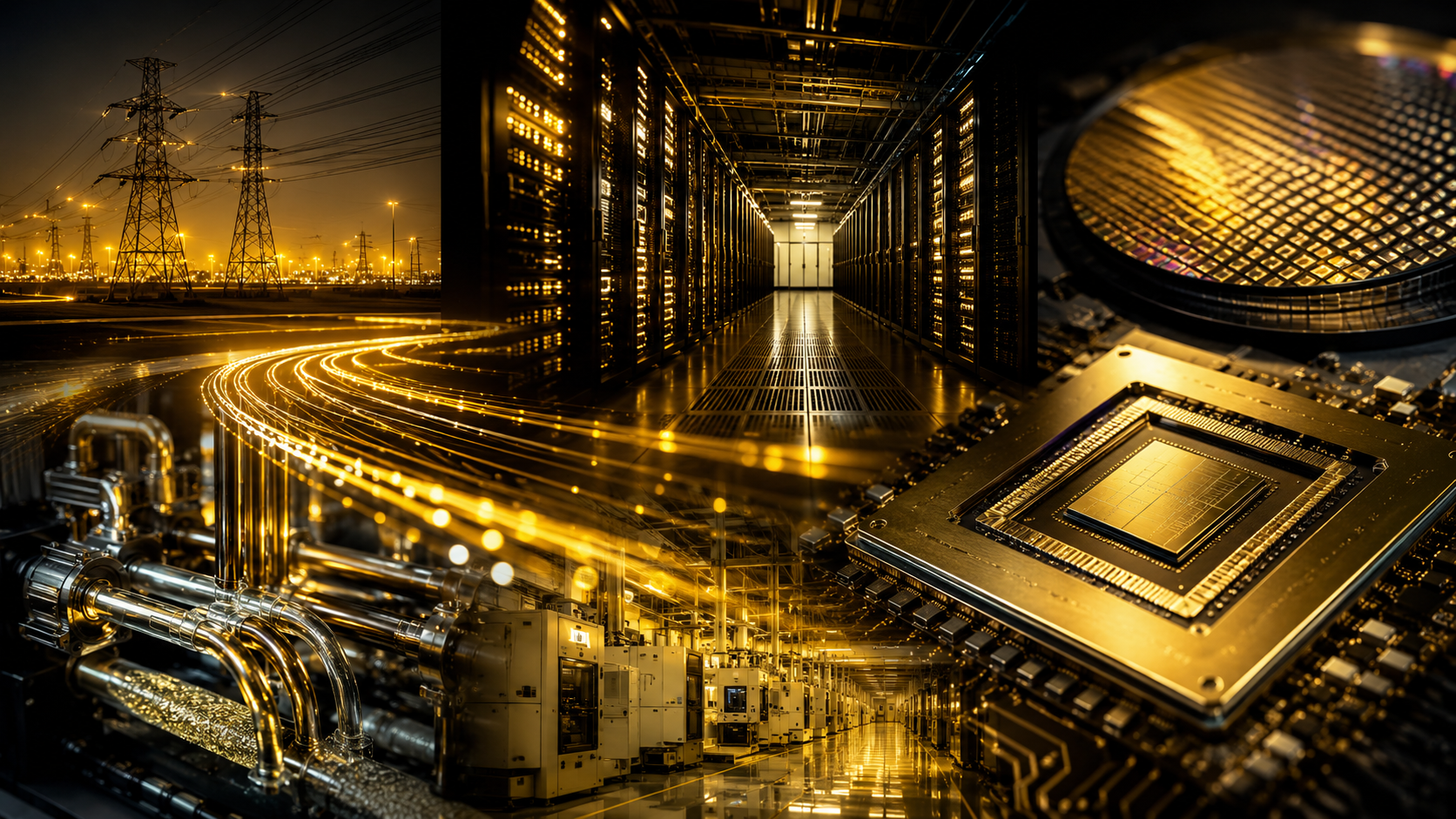
Artificial intelligence is no longer just a software story. The real battle is now happening deep inside data centers, semiconductor fabs, power grids, networking systems, memory platforms, and cooling facilities.
The biggest winners in the next phase of AI may not only be chatbot makers or cloud software companies. The companies building the physical backbone of artificial intelligence are becoming among the most important players in the AI economy.
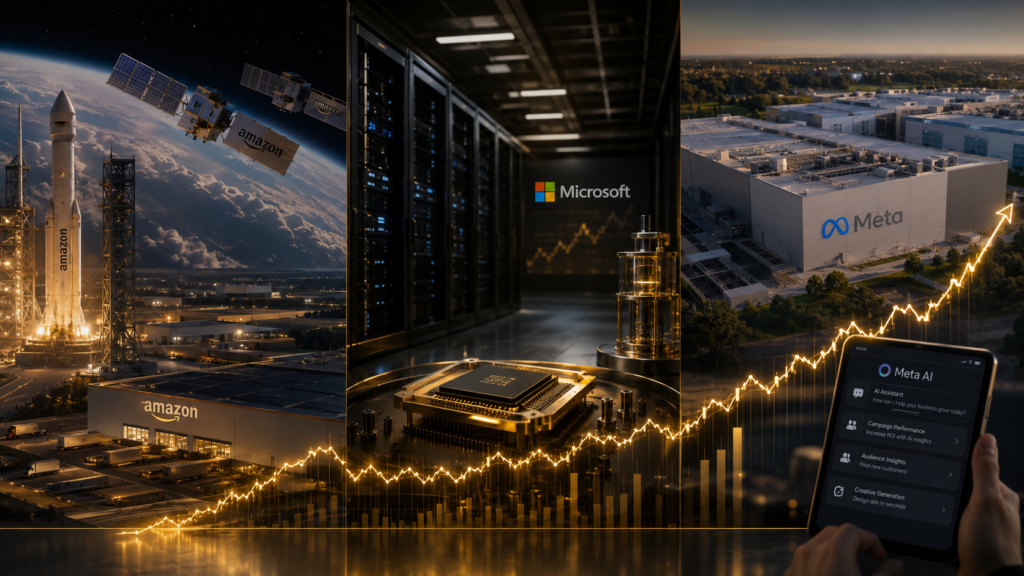
Reuters reported in late April that Microsoft, Alphabet, Amazon, and Meta Platforms are on track to spend about $600 billion on AI infrastructure this year, a historic wave of spending that is testing cash flows while reshaping global technology investment.
The International Energy Agency also expects global data center electricity consumption to more than double to around 945 terawatt-hours by 2030, with AI becoming a major driver of that growth.
That explains why investors are increasingly looking beyond software stocks. The next AI winners may be the companies supplying chips, memory, optical connectivity, networking systems, power equipment, cooling technology, and advanced manufacturing tools needed to keep artificial intelligence expanding at scale.
Here are 10 AI infrastructure stocks attracting serious attention as the next stage of the AI boom accelerates.
10. NVIDIA Corporation (NVDA)
NVIDIA (NASDAQ: NVDA) remains one of the most dominant forces in artificial intelligence. The company already leads the GPU market, but its latest moves suggest it wants to control far more than just processors.
On May 6, NVIDIA announced a long-term partnership with Corning to expand U.S.-based optical connectivity manufacturing. The project includes three advanced manufacturing facilities in North Carolina and Texas and is expected to create more than 3,000 jobs.
The strategy targets one of the biggest hidden challenges inside AI data centers. Modern AI systems move enormous amounts of data between processors every second. Slower connectivity can create major bottlenecks even when advanced GPUs are available.
NVIDIA develops graphics processors, accelerated computing platforms, AI networking systems, robotics technologies, automotive solutions, and data center infrastructure products. The company remains at the center of the global AI infrastructure race.
9. Taiwan Semiconductor Manufacturing Company Limited (TSM)
Almost every major AI chip company depends on one critical player behind the scenes: TSMC.
The semiconductor giant reported strong first-quarter 2026 results, with revenue reaching $35.90 billion in U.S. dollar terms, up 40.6% year over year. Net income and diluted EPS both increased 58.3%, while gross margin reached 66.2%.
Those numbers reflect more than strong chip demand. They show how critical advanced manufacturing capacity has become in the AI era.
TSMC said 3nm technology accounted for 25% of wafer revenue during the quarter, while 5nm and 7nm technologies accounted for 36% and 13%, respectively. Advanced technologies, defined as 7nm and below, made up 74% of total wafer revenue.
That matters because the world’s most advanced AI accelerators rely heavily on these manufacturing processes. The AI boom may shift between cloud companies, software developers, and chip designers, but most advanced AI processors still need TSMC’s manufacturing capacity before reaching the market.
8. Broadcom Inc. (AVGO)
Broadcom (NASDAQ: AVGO) is quietly becoming one of the most influential companies in custom AI silicon.
According to Bloomberg and SDxCentral reports, Blackstone and Apollo Global Management have been in discussions over a roughly $35 billion financing package tied to Broadcom’s AI chip development plans. The potential deal would be among the largest private credit transactions tied to the AI buildout.
The reason is simple. The race to build custom AI processors is becoming extremely expensive. Major AI companies increasingly want specialized chips designed for their own workloads instead of relying entirely on standard accelerators.
Broadcom has already been linked to major custom silicon relationships with large technology companies, including Meta and Google. Reports have also connected the company to custom AI accelerator development for other leading AI players.
Broadcom develops custom AI accelerators, networking chips, cybersecurity software, storage connectivity products, broadband technologies, and cloud infrastructure solutions. The company is positioning itself as a major supplier in the next phase of enterprise AI computing.
7. ASML Holding N.V. (ASML)
AI chips cannot exist without advanced lithography machines. That reality places ASML (NASDAQ: ASML) in one of the strongest strategic positions across the semiconductor industry.
ASML raised its 2026 sales outlook to €36 billion–€40 billion, driven by rising demand for high-power AI chips. The company reported first-quarter 2026 net sales of €8.8 billion and net income of €2.8 billion.
The company’s extreme ultraviolet lithography systems are essential for producing chips at advanced nodes such as 7nm, 5nm, and 3nm. Its High NA EUV technology is also expected to support future 2nm and sub-2nm production.
That means nearly every advanced AI processor relies on ASML technology at some stage of the manufacturing process.
ASML develops lithography systems, inspection equipment, and metrology solutions used by semiconductor manufacturers worldwide.
6. Advanced Micro Devices, Inc. (AMD)
AMD is pushing far beyond being an NVIDIA competitor.
The company reported first-quarter 2026 data center revenue of $5.8 billion, up 57% year over year. Growth was driven by strong demand for AMD EPYC processors and the continued ramp of AMD Instinct GPU shipments.
AMD is also expanding its enterprise AI footprint through partnerships with major server and infrastructure providers. Its AI accelerators and server processors are increasingly positioned for companies that want to run larger AI models while managing memory, cooling, and power requirements inside existing data centers.
That approach could become important as businesses search for practical ways to integrate AI without rebuilding entire facilities.
AMD develops CPUs, GPUs, AI accelerators, embedded processors, and adaptive computing technologies across multiple industries.
5. Arista Networks, Inc. (ANET)
AI systems need far more than powerful chips. They also need ultra-fast networking capable of moving enormous amounts of data across thousands of GPUs with minimal delay.
That is where Arista Networks (NYSE: ANET) is making aggressive moves.
Arista reported first-quarter 2026 revenue of $2.709 billion, up 35.1% from the first quarter of 2025. The company also reported strong operating margins, showing that demand for cloud and AI networking remains strong.
The company has also introduced AI-focused networking technologies, including XPO high-density liquid-cooled pluggable optics. Arista said the technology delivers 12.8 Tbps per pluggable module and 204.8 Tbps per OCP rack unit.
Arista provides cloud networking, AI networking, automation software, routing systems, security technologies, and data center switching products. As AI clusters grow larger, networking performance is becoming one of the most important parts of the infrastructure stack.
4. Vertiv Holdings Co. (VRT)
The AI industry is discovering that cooling and power management are becoming just as important as chips themselves.
Hut 8 recently announced a 15-year lease tied to the first phase of its Beacon Point AI data center campus in Texas. The deal covers 352 megawatts of IT capacity and carries a base-term contract value of $9.8 billion. Reuters reported that the facility is being developed in partnership with American Electric Power, Vertiv (NYSE: VRT), and Jacobs, and will use NVIDIA data center systems.
That highlights how critical companies like Vertiv have become to the AI buildout.
Vertiv focuses on thermal management, liquid cooling, power systems, modular infrastructure, monitoring software, and rack technologies used in modern data centers. As AI facilities consume more electricity and generate more heat, Vertiv’s role in cooling and power management is becoming increasingly important.
3. Eaton Corporation plc (ETN)
One of the clearest signs of the AI infrastructure boom is appearing in the power management sector.
Eaton (NYSE: ETN) reported that data center orders in its Electrical Americas business jumped approximately 240% in the first quarter of 2026. Data center revenue increased approximately 50% year over year, while the Electrical Americas backlog expanded 44%.
Those numbers suggest that demand for electrical systems is accelerating rapidly as AI data centers expand across the United States.
Eaton also collaborated with NVIDIA on the Eaton Beam Rubin DSX platform, a grid-to-chip architecture designed to support AI factory infrastructure. The platform focuses on modular scalability, faster deployment, power distribution, and cooling infrastructure for large AI deployments.
Eaton provides electrical systems, backup power solutions, switchgear equipment, power distribution products, and industrial infrastructure technologies.
2. Micron Technology, Inc. (MU)
The AI race is creating explosive demand for memory and high-density storage systems.
Micron (NASDAQ: MU) announced it is shipping the 245TB Micron 6600 ION data center SSD, which the company describes as an industry-leading high-capacity drive designed for AI, cloud, enterprise, and hyperscale workloads.
The product targets AI data lakes, cloud infrastructure, enterprise storage systems, and hyperscale computing environments. Micron says the drive can help data centers increase storage density while reducing power and cooling requirements.
Those improvements matter because AI systems require enormous volumes of training data and constant access to high-speed storage infrastructure.
Micron develops DRAM, NAND, NOR memory products, high-bandwidth memory solutions, and SSD technologies used across AI infrastructure and cloud computing.
1. Marvell Technology, Inc. (MRVL)
Marvell (NASDAQ: MRVL) is rapidly emerging as one of the most important networking and custom silicon companies in artificial intelligence.
On April 22, the company announced the acquisition of Polariton Technologies, a developer focused on plasmonics-based silicon photonics technology. Marvell said the acquisition strengthens its ability to scale optical performance to 3.2T and beyond.
The company is also expanding its role in advanced AI connectivity. Reports have linked Marvell to NVIDIA’s NVLink Fusion ecosystem, which is designed to allow third-party silicon to connect directly into NVIDIA’s AI infrastructure.
Marvell develops custom silicon, optical connectivity products, Ethernet technologies, data center switching systems, storage infrastructure, and cloud networking solutions.
Its position at the intersection of networking, photonics, and custom AI computing could make Marvell one of the most closely watched AI infrastructure stocks moving forward.
Why These AI Infrastructure Stocks Are Becoming Wall Street Favorites
The next stage of the AI boom is no longer focused only on software applications. The real money is increasingly flowing toward the physical infrastructure powering artificial intelligence behind the scenes.
Advanced chips still require manufacturing capacity. AI clusters still need high-speed networking systems. Massive data centers still require cooling technology, electricity, storage hardware, optical connectivity, and power management systems.
That is why investors are watching companies such as NVIDIA, TSMC, Broadcom, ASML, AMD, Arista, Vertiv, Eaton, Micron, and Marvell so closely.
These companies are not just supporting the AI boom. They are building the backbone that allows it to scale. As artificial intelligence continues to expand across industries, the infrastructure companies behind the scenes may become some of the biggest long-term winners of the AI revolution.