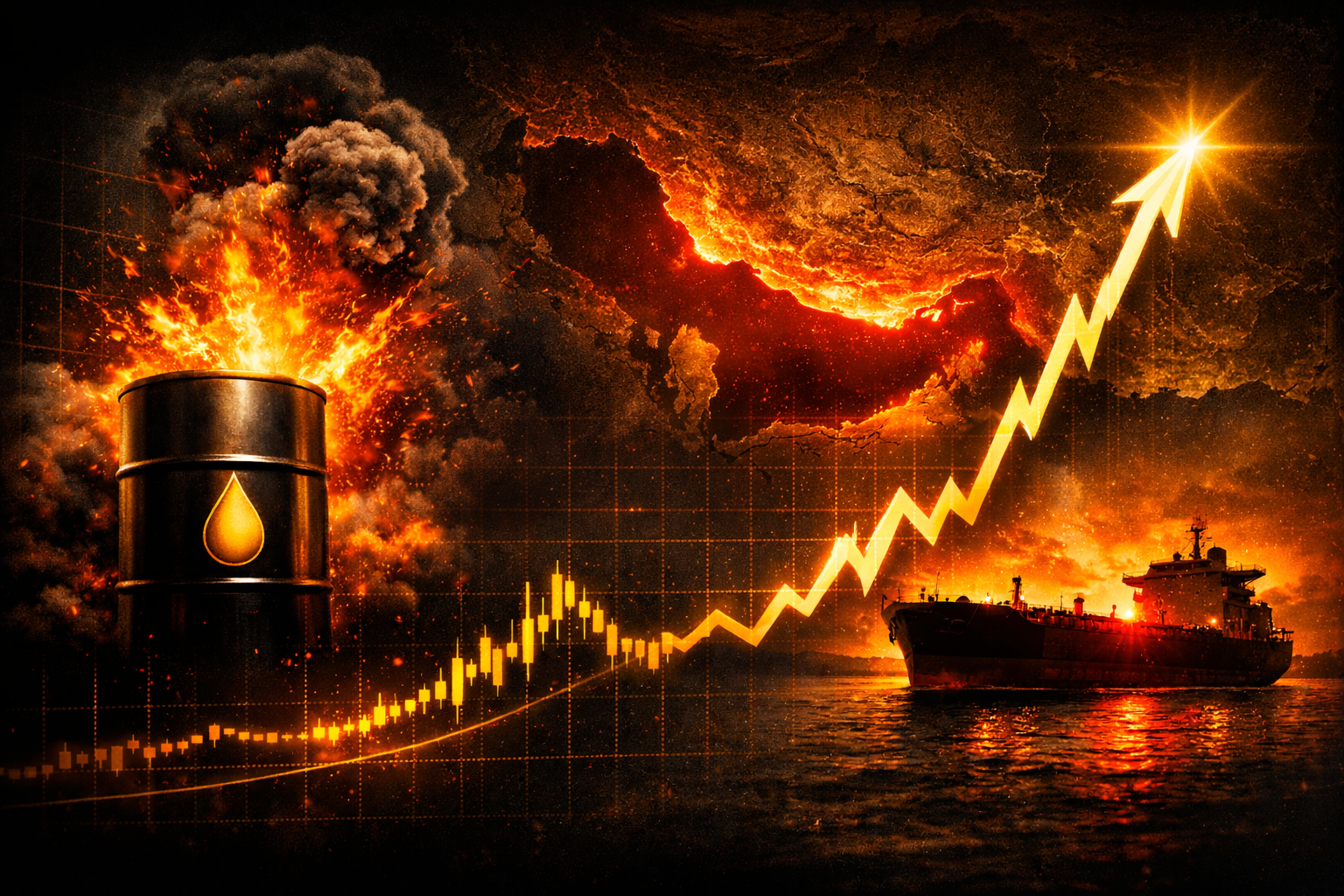
Oil has surged back into crisis territory after the collapse of talks between the United States and Iran, triggering a global market reset. Behind the calm surface of equities, a deeper inflation and supply shock is already unfolding.
A Sudden Shock That Reset the Global Market
The global financial system has been jolted again. Over the weekend, negotiations between the United States and Iran collapsed, and Washington moved to block ships departing Iranian ports. That single development pushed oil markets back into crisis mode almost instantly.
Prices reacted with speed and force. Brent crude climbed to 99.82 with a sharp gain of 4.85 percent. At the same time, U.S. West Texas Intermediate surged to 103.42 with a 7.09 percent jump as of 1:10 p.m. UTC. These numbers reflect more than a simple rebound. They signal a market that is rapidly pricing in disruption.
The reaction spread far beyond oil. Currency markets shifted, equities moved unevenly, and investors began repositioning for risk.
Markets Look Calm, but Under Pressure Is Building
At first glance, major U.S. indices appear stable. The S&P 500 closed at 6,848.63 with a gain of 0.47 percent. The Nasdaq Composite rose to 23,060.16 with an increase of 0.69 percent. The Dow Jones Industrial Average edged higher to 47,924.67 with a modest 0.02 percent rise.
However, the calm masks underlying stress. Earlier in the trading session at 11:50 a.m. ET, the Dow was down 255.39 points or 0.53 percent. The S&P 500 remained flat, while the Nasdaq gained 64.35 points or 0.28 percent. Market breadth revealed deeper concern. On the NYSE, declining stocks outnumbered advancing ones by a ratio of 1.22 to 1. On the Nasdaq, the ratio stood at 1.18 to 1.
These figures show that investors were uneasy even before the full impact of the geopolitical escalation became clear.
The Real Fear Is Not Oil Prices but Supply Collapse
This is no longer a simple story of supply and demand. The market is now reacting to a potential disruption in the Strait of Hormuz, a route responsible for about 20 percent of the world’s daily energy supply.
The physical oil market is already flashing warning signs. Crude cargoes for immediate delivery to Europe have reached nearly $150 per barrel, marking a record. This divergence between physical and futures pricing highlights a deeper supply stress. OPEC has responded by cutting its second-quarter demand forecast by 500,000 barrels per day. At the same time, OPEC+ reported a production drop of 7.7 million barrels per day in March.
These are not small adjustments. They reflect a scenario in which the Strait of Hormuz could effectively close, pushing global fuel prices sharply higher and intensifying inflationary pressures.
From Hope to Fear in Just Days
The current crisis marks a dramatic reversal from just days ago. On April 8, optimism drove markets higher after a ceasefire agreement between the United States and Iran. The Dow surged 2.85 percent, the S&P 500 climbed 2.51 percent, and the Nasdaq jumped 2.80 percent. Oil prices fell below $100, and energy stocks declined as the market priced in reduced geopolitical risk.
By April 10, confidence had already begun to fade. The Dow slipped 0.56 percent, the S&P 500 dipped 0.11 percent, and the Nasdaq gained 0.35 percent. Investors were clearly waiting for clarity on whether negotiations would hold. Now that those talks have failed, the market has fully shifted from a peace-driven rally to a risk-driven environment.
Winners and Losers in a High Oil World
The surge in oil prices is creating clear divides across sectors.
Energy companies are benefiting. Chevron stock (NYSE: CVX) gained 1.59 percent, Exxon Mobil stock (NYSE: XOM) rose 1.09 percent, and ConocoPhillips stock (NYSE: COP) advanced 1.3 percent. The broader energy sector increased by 1.08 percent. On the other side, travel companies are under pressure due to rising fuel costs. Delta Air Lines shares (NYSE: DAL) dropped 2.81 percent, while Southwest Airlines stock (NYSE: LUV) fell 2.77 percent.
There are also company-specific movements shaping the market. Goldman Sachs shares (NYSE: GS) declined 3.14 percent following its earnings report. Allogene Therapeutics stock (NASDAQ: ALLO) surged 25.74 percent, and Albemarle stock (NYSE: ALB) gained 7.98 percent. Sandisk shares (NASDAQ: SNDK) rose 5.87 percent as it moves closer to joining the Nasdaq 100 on April 20.
This mix shows that while oil is driving the macro story, individual company fundamentals still matter.
The Inflation Threat Returns to the United States
For the United States, the immediate impact is clear. Rising oil prices are feeding directly into gasoline costs and inflation.
The national average gasoline price crossed $4 per gallon in late March. With crude prices climbing again, inflation concerns are returning to the forefront. This creates a challenge for the Federal Reserve. Higher energy costs could force policymakers to remain cautious for longer, especially if inflation remains elevated.
At the same time, the U.S. dollar is strengthening as investors seek safety. This is a typical reaction during geopolitical uncertainty, but it also adds pressure on global markets and risk-sensitive currencies.
A Global Shock That Is Already Spreading
The impact is not limited to the United States. This situation is being treated as a major global economic shock.
International institutions are preparing to adjust their outlook. Growth forecasts are expected to decline, while inflation projections are likely to rise. Governments are already responding. Germany and Sweden are rolling out fuel tax relief and energy support measures. In Nigeria, the impact has been severe, with petrol prices rising more than 50 percent and diesel prices increasing more than 70 percent since the conflict began.
This is not just a price spike. It is a structural supply issue that could affect economies worldwide.
What Comes Next for Oil and the Global Economy
Forecasts suggest that elevated oil prices may persist. Morgan Stanley expects Brent crude to average around $110 in Q2 2026, $100 in Q3 2026, and $80 in 2027. However, even if the Strait of Hormuz reopens, supply chains may take months to stabilize. This means the economic effects could last far longer than the initial shock.
The Bigger Picture That Investors Cannot Ignore
The market is sending a clear message. Oil prices are rising rapidly. Energy companies are gaining strength. Broader equity markets are holding steady but showing signs of strain beneath the surface.
This is not yet a full-scale market panic. Instead, it is a recalibration. Investors are treating this as an inflation-driven geopolitical shock rather than an immediate collapse in growth.
But the risks are building. With supply under pressure, inflation rising, and uncertainty increasing, the global economy is entering a tighter energy environment that could shape markets for months to come.