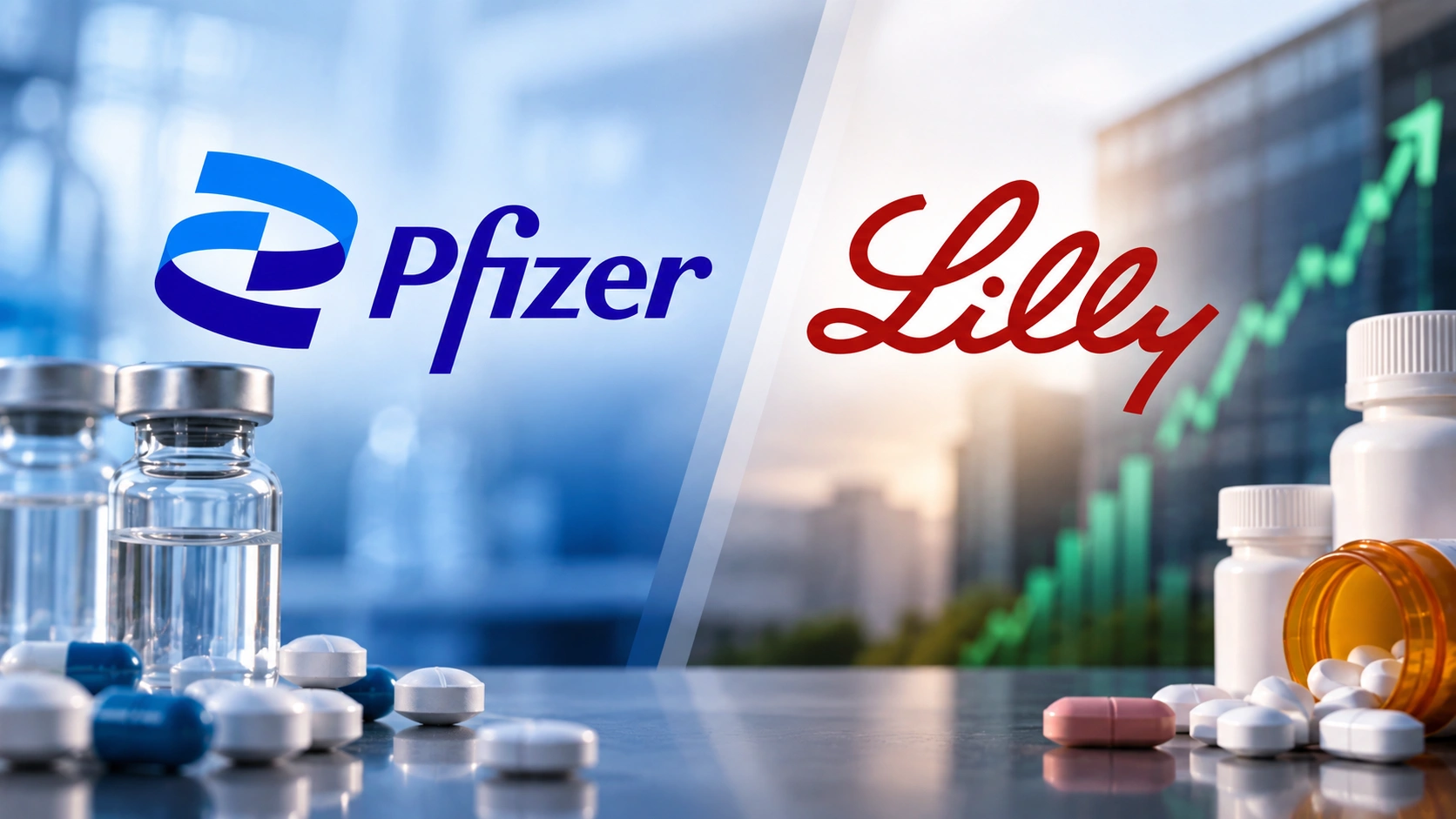
Pfizer Inc. (NYSE: PFE) and Eli Lilly and Company (NYSE: LLY) head into the new trading week with fresh U.S. drug-pricing policy risk in focus after previously confidential agreements with the federal government were released over the weekend.
The documents, obtained by consumer advocacy group Public Citizen through a Freedom of Information Act lawsuit, provide new detail on the companies’ most-favored-nation, or MFN, pricing arrangements with the Trump administration. The disclosures came after U.S. markets closed Friday, meaning their potential effect was not reflected in Sept. 18 regular-session prices.
For Pfizer, the most significant newly disclosed provision requires the company to provide the United States with a redacted share of incremental net revenue generated when prices on existing medicines rise overseas. Lilly’s documents, meanwhile, reveal additional mechanics around international reference pricing. Both companies also remain exposed to the broader expansion of MFN pricing across state Medicaid programs.
Pfizer’s Overseas Revenue Provision Adds a New Variable
The White House disclosed in September 2025 that Pfizer would be required to direct increased foreign revenue generated by U.S. trade policies toward the benefit of American patients. The newly released agreement adds detail by showing that Pfizer must provide some of that incremental revenue to the United States, with HHS working with the company to determine how the obligation is fulfilled.
The public version does not identify the ultimate recipient agency or payment mechanism. The provision applies beginning Jan. 1, 2026, while Pfizer’s definitive agreement was signed by the company on Feb. 23, 2026. The agreement is scheduled to continue through Jan. 20, 2029, unless terminated earlier. The revenue-sharing percentage, covered products, and other financial terms remain redacted.
As a result, the potential financial effect cannot yet be calculated.
That distinction matters for Pfizer investors. Higher international prices could theoretically offset part of the pressure from lower U.S. prices, but the sharing requirement means Pfizer may not retain all of that upside. Until the covered products, sharing rate, and applicable foreign markets are disclosed, the effect on revenue and margins remains uncertain.
Pfizer said through a spokesperson that its agreement is intended to lower patient prices, redistribute the global cost of pharmaceutical research and development and create a more predictable environment for U.S. investment. The administration has similarly argued that additional foreign revenue should benefit U.S. patients rather than accrue entirely to drugmakers.
Pfizer CEO Albert Bourla had told investors only days earlier that he viewed MFN pricing and tariff uncertainty as major 2025 challenges that the company had largely resolved. At Morgan Stanley’s healthcare conference on Sept. 14, Bourla said Pfizer’s attention was increasingly shifting toward its pipeline after working through pricing, tariff, and COVID-related uncertainty.
In addition, the pricing agreements provide tariff relief. Pfizer disclosed in its second-quarter 2026 filing that the applicable Section 232 tariff rate for Pfizer products will be zero through Jan. 20, 2029, under its final agreements with the U.S. government. Lilly said its November 2025 agreement provides three years of tariff relief.
Those protections reduce both companies’ exposure to pharmaceutical tariffs alongside the pricing commitments contained in the agreements.
The weekend disclosure therefore gives investors additional detail on an issue Pfizer management had characterized as largely settled.
Lilly Agreement Puts International Reference Prices Under Scrutiny
Lilly’s agreement remains heavily redacted, but Public Citizen said the disclosed language allows the company, under certain circumstances, to stop supplying a medicine in a reference country and have that country’s price removed from the MFN calculation after notifying the U.S. government.
That is Public Citizen’s interpretation of the agreement rather than a newly announced Lilly policy, and substantial portions of the contract remain unavailable. The organization said the redactions make the full economic impact difficult to determine.
The released material also draws an important distinction for Lilly’s largest GLP-1 medicines. Public Citizen’s analysis says Mounjaro and Zepbound are excluded from Lilly’s GENEROUS covered-product definition. CMS’s separate BALANCE model includes all formulations of Mounjaro and the KwikPen formulation of Zepbound.
That limits the direct exposure of Lilly’s two largest growth products to the GENEROUS rollout.
Lilly’s exposure to government pricing policy remains important because obesity drugs have become central to its growth. The company’s November 2025 agreement with the U.S. government expanded government-program access to Zepbound and its oral obesity treatment, now marketed as Foundayo, while reducing prices through Medicare, Medicaid, and direct-pay channels. Commercial insurance pricing was not included in that arrangement.
Lilly reported second-quarter 2026 revenue of $23.0 billion, up 48% from a year earlier, driven primarily by Mounjaro and Zepbound. The company raised full-year revenue guidance to $85 billion to $87 billion.
Realized prices declined 13% during the quarter even as overall volume rose 60%, illustrating why pricing and access changes remain financially important despite exceptionally strong demand. Notably, Mounjaro and Zepbound accounted for 65% of Lilly’s total revenue during the first six months of 2026, according to the company’s second-quarter filing.
Medicaid MFN Rollout Moves Toward Implementation
The contract disclosures came alongside another policy development Friday: CMS said every state Medicaid program, the District of Columbia, and Puerto Rico had applied to participate in the GENEROUS drug-pricing model.
Forty states and Puerto Rico had already signed participation agreements as of Sept. 18, according to CMS, with the remaining states given until Sept. 30 to finalize participation. CMS estimates the program could save federal and state taxpayers $64.3 billion over 10 years.
Under GENEROUS, participating drugmakers provide supplemental rebates intended to align Medicaid net prices on covered medicines with prices paid in selected foreign markets. Pfizer and Lilly are among the companies that have reached MFN agreements with the administration.
For shareholders, the central issue is the balance between lower unit pricing and potentially wider patient access.
Lilly’s exposure under GENEROUS is narrower for its two biggest GLP-1 products because Mounjaro and Zepbound fall outside the covered-product definition in the released agreement. The financial effect will therefore depend on Lilly’s other covered medicines, supplemental rebates, coverage rules, and utilization.
Heavy Friday Volume Came Before The Weekend Disclosure
Pfizer closed Friday at $27.66, up 0.07% for the session and 11.08% year to date. About 75.59 million shares changed hands, roughly 85% above the stock’s three-month average volume of 40.82 million.
Lilly finished at $1,152.93, up 0.04%, with about 4.55 million shares traded versus a three-month average of roughly 2.70 million. The stock was up 7.28% for 2026 through Friday.
The elevated turnover should not be interpreted as a reaction to the weekend contract disclosures. Friday was a quarterly triple-witching session, when stock options and index derivatives expire simultaneously, a market event that commonly produces unusually heavy trading volumes.
Roughly $7 trillion of U.S. options notional value was due to expire Friday, according to Citadel Securities data reported by Bloomberg.
That makes Monday’s session the first opportunity for investors to directly price the newly disclosed contract terms.
What Comes Next for PFE and LLY
The immediate measurable factor will be how Pfizer and Lilly trade when U.S. markets reopen Monday, particularly whether investors view the newly visible provisions as financially significant or largely consistent with assumptions already embedded in the stocks.
Beyond the initial market reaction, investors will be watching for disclosure of the still-redacted economics, including Pfizer’s foreign-revenue-sharing percentage, the specific drugs covered by the agreements, international reference-price calculations and the coverage criteria attached to Medicaid participation.
The Sept. 30 deadline for remaining states to finalize GENEROUS participation is another near-term policy milestone.
Pfizer also faces a separate policy variable involving pharmaceutical licensing from China. The U.S. Treasury Department is drafting rules that would likely allow American drugmakers to continue licensing most drug candidates from Chinese companies while restricting transactions involving pathogens or biotechnology with potential weapons applications, Reuters reported. The rules are not final and remain subject to change.
The issue is particularly relevant to Pfizer, which has argued against broad restrictions on Chinese pharmaceutical licensing and recently entered a collaboration with Innovent Biologics covering 12 oncology programs with potential payments of up to $10.5 billion. Pfizer has also said it expects China to remain a significant source of earlier-stage business-development opportunities.
Bourla told the Morgan Stanley conference that Chinese drug developers can operate substantially faster and at lower cost than many Western peers and that Pfizer intends to remain active in sourcing innovation there.
Until the remaining contract terms and policy details emerge, the weekend disclosures provide investors with greater transparency but still not enough financial information to calculate a definitive earnings impact for either Pfizer or Lilly.