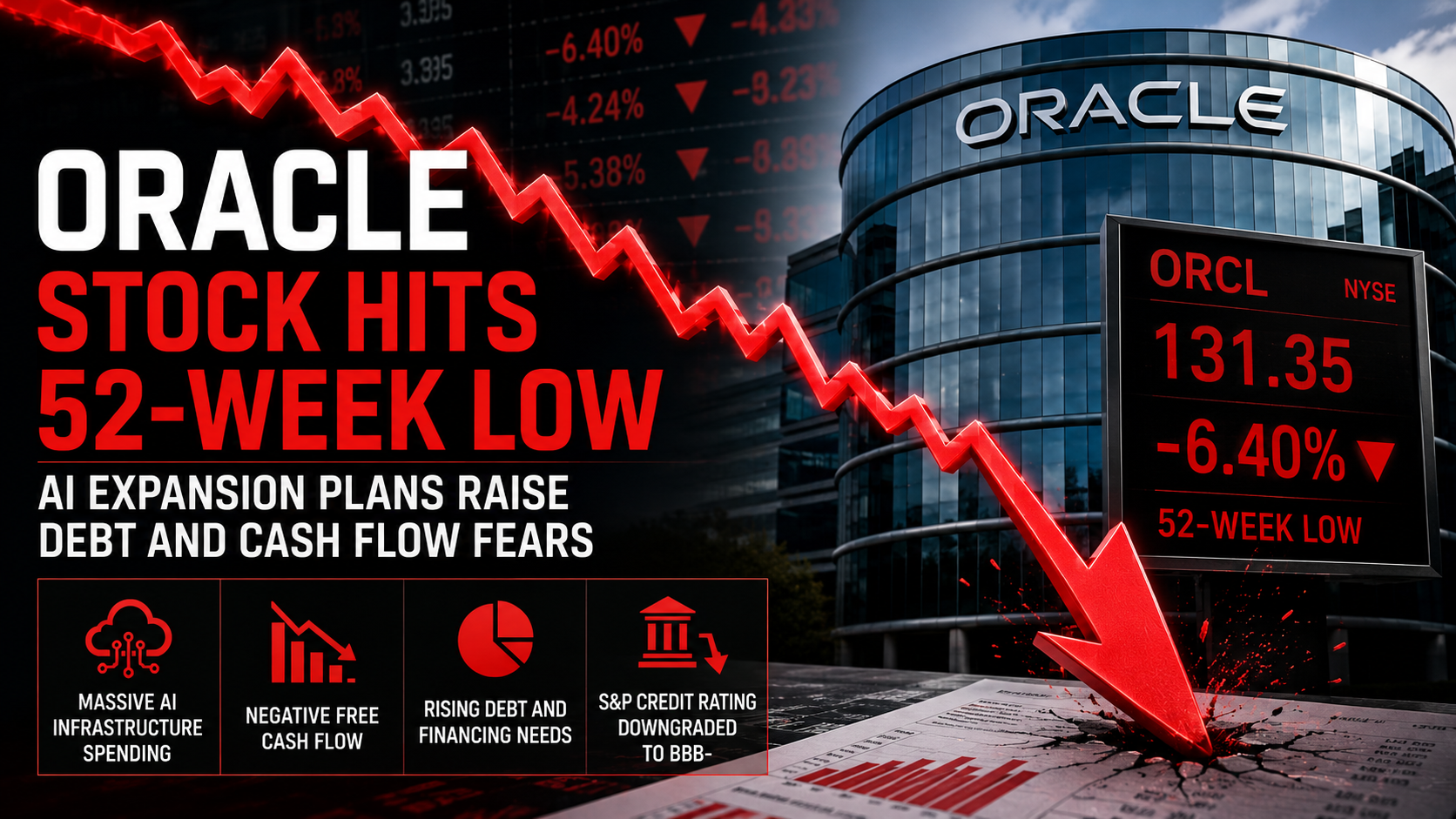
Oracle (NYSE: ORCL) shares tumbled 6.4% on Monday to close at $131.70 after touching an intraday low of $131.35, marking a fresh 52-week low, as investors continued to focus on the software giant’s mounting AI infrastructure spending, rising debt and deteriorating free cash flow despite strong cloud growth.
The latest decline extends a selloff that has persisted since Oracle reported fiscal fourth-quarter 2026 results on June 10, when the company delivered stronger-than-expected cloud growth but unveiled plans for unprecedented capital spending to expand its AI infrastructure business.
Investors Are Prioritizing Cash Flow Over Revenue Growth
Oracle’s operating performance remains robust.
The company reported 21% year-over-year revenue growth in its fiscal fourth quarter, while Oracle Cloud Infrastructure (OCI) revenue jumped 93%, driven by demand for AI computing services. Management also highlighted a rapidly expanding backlog of contracted cloud business, reinforcing expectations for continued revenue growth.
However, investors have shifted their attention from revenue growth to the cost of achieving it.
Oracle generated a negative free cash flow of $23.7 billion in fiscal 2026 after sharply increasing capital expenditures to build AI data centers. Management expects capital expenditures to rise further to approximately $70 billion in fiscal 2027from $55.7 billion in fiscal 2026. Meanwhile, it also plans to raise roughly $40 billion through debt and equity financing to fund the expansion. Those figures have intensified concerns over leverage, financing costs, and potential shareholder dilution.
Credit Downgrade Reinforces Balance Sheet Concerns
Investor sentiment deteriorated further after S&P Global Ratings downgraded Oracle’s long-term issuer credit rating to BBB-, one notch above speculative/junk grade.
The agency cited expectations that Oracle’s leverage will remain elevated as it finances one of the largest AI infrastructure buildouts in the technology sector. A weaker credit profile could increase borrowing costs at a time when the company is relying heavily on external financing.
Unlike Microsoft (NASDAQ: MSFT) and Amazon (NASDAQ: AMZN), whose AI investments are primarily anchored by massive operating cash flows, Oracle is pursuing a significantly more debt-intensive expansion strategy, making execution and financing equally important to investors.
Wall Street Remains Bullish—but Is Becoming More Selective
Despite the recent sell-off, several Wall Street firms continue to maintain a constructive view of Oracle’s long-term AI strategy.
KeyBanc reiterated a “Buy” rating with a $300 price target; Mizuho maintained a “Buy” rating and $320 target, while Evercore ISI reaffirmed an “Outperform” rating with a $245 target, reflecting confidence that Oracle’s AI cloud investments could translate into stronger long-term earnings as additional capacity comes online.
Not every analyst has become more optimistic.
Last month, Freedom Broker lowered its price target to $210 from $230, while maintaining a “Buy” rating. The firm said Oracle’s cloud transformation and AI backlog remain compelling but believes investor focus has shifted from demand to whether the company can finance its expansion, convert its backlog into revenue, and preserve its credit profile.
AI Demand Remains Strong, but Execution Is the Next Test
Oracle continues to benefit from strong demand for AI infrastructure.
The company has secured major cloud infrastructure agreements with customers including OpenAI and Meta Platforms (NASDAQ: META), contributing to a substantial increase in remaining performance obligations (RPO), a key indicator of future contracted revenue. Those agreements position Oracle among the fastest-growing providers of AI infrastructure services.
The next challenge is execution.
Building AI data centers requires significant upfront investment in GPUs, networking equipment, advanced cooling systems and power infrastructure well before associated revenue is recognized. Investors are increasingly watching whether Oracle can convert its growing backlog into sustainable earnings and positive free cash flow without further straining its balance sheet.
Why Investors Should Care
Oracle’s decline reflects a broader shift in how investors evaluate AI companies.
For much of the past two years, markets rewarded companies that announced larger AI investments. More recently, investors have become increasingly focused on whether those investments can generate attractive returns without materially weakening balance sheets.
For Oracle, the next catalysts include improvements in free cash flow, progress in converting its AI backlog into recognized revenue, financing updates, and management’s ability to demonstrate that record capital expenditures are beginning to produce operating leverage.
Until those metrics improve, Oracle’s share price is likely to remain driven as much by its funding strategy as by continued strength in cloud revenue growth.