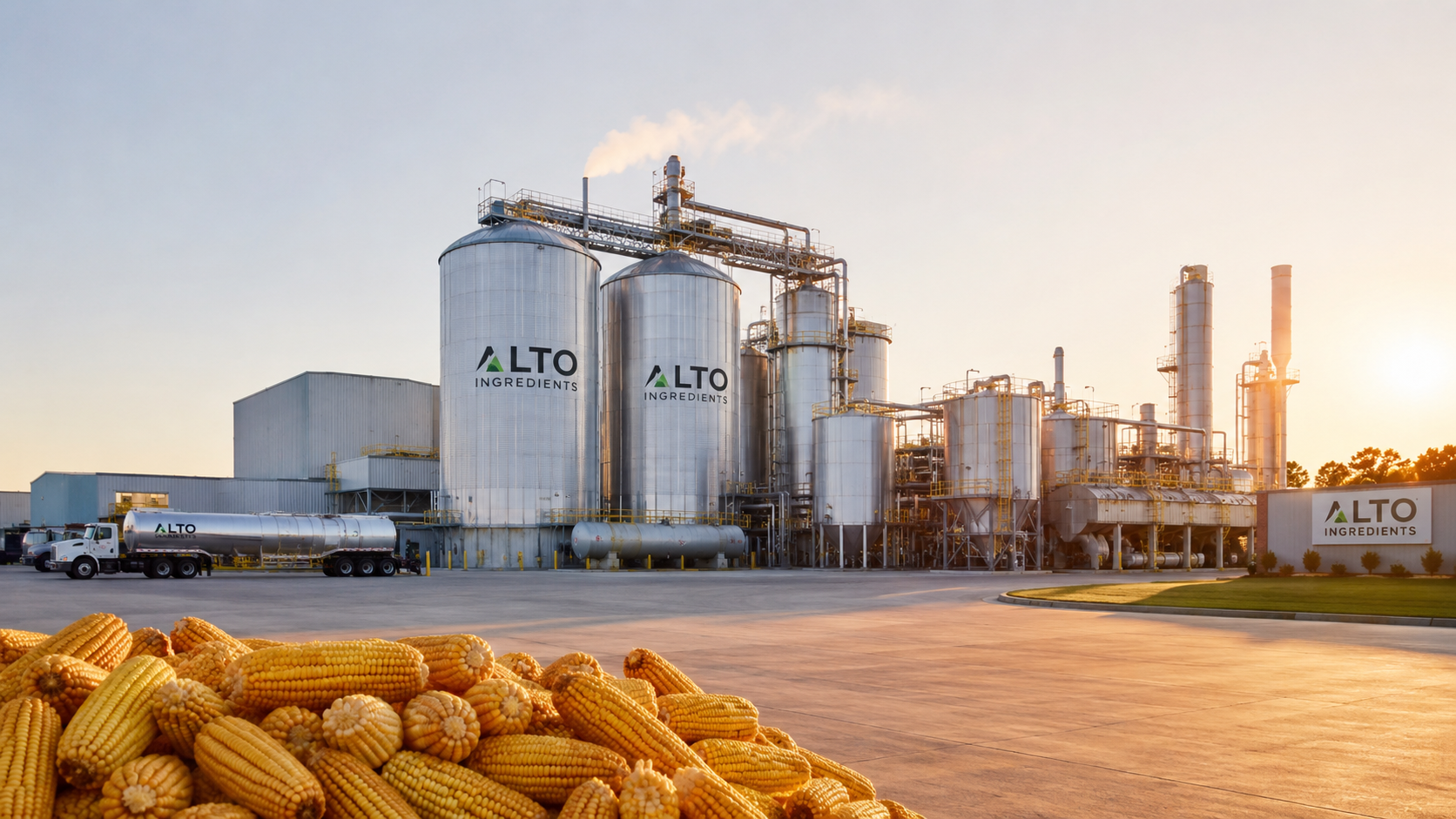
Investors researching ALTO stock will find a company that appears inexpensive by some traditional valuation measures but has a long history of volatile earnings.
That combination raises an important question: Is Alto Ingredients (NASDAQ: ALTO) an undervalued turnaround opportunity, or is it simply another cyclical ethanol producer whose fortunes depend on unpredictable commodity markets?
The answer depends on whether Alto can convert improving production margins, clean-fuel incentives, and higher-value products into recurring operating profits and free cash flow.
Alto Ingredients’ results can change significantly as corn prices, ethanol prices, natural gas costs, specialty alcohol demand, export activity, derivative positions, and federal clean-fuel incentives move throughout the year. Those variables make ALTO stock more complicated than a basic valuation screen might suggest.
However, the company has recently returned to profitability, reduced term debt, monetized its 2025 clean-fuel tax credits, and gained inclusion in the Russell 2000 and Russell 3000 indexes.
This article explains how Alto Ingredients generates revenue, why its earnings fluctuate, and which catalysts could determine whether the recent turnaround becomes sustainable.
ALTO Stock at a Glance
Alto Ingredients traded near $5.08 during early trading on July 23, 2026, giving the company a market capitalization of approximately $393.6 million. Its trailing price-to-earnings ratio was around 13.7, although that figure should be interpreted cautiously because recent earnings included tax-credit income and derivative gains.
The trailing ratio is based on earnings from the most recent four reported quarters, from the second quarter of 2025 through the first quarter of 2026, rather than Alto’s full-year 2025 diluted earnings of $0.16 per share. Because the reported quarterly EPS figures are rounded, the exact trailing multiple may vary slightly depending on the calculation method. Using the 2025 calendar-year EPS alone would produce a considerably higher multiple.
| Metric | Latest Figure |
|---|---|
| Stock symbol | ALTO |
| Exchange | Nasdaq |
| Recent share price | Approximately $5.08 |
| Market capitalization | Approximately $393.6 million |
| Trailing P/E ratio | Approximately 13.7 |
| Shares outstanding | Approximately 77.5 million |
| Dividend | None |
| Latest reported quarter | First quarter of 2026 |
Alto Ingredients had approximately 77.5 million common shares outstanding as of May 7, 2026.
Investors should not confuse Alto Ingredients (NASDAQ: ALTO) with Palo Alto Networks (NASDAQ: PANW), Alto Neuroscience (NYSE: ANRO), or the Alto rideshare company. They are entirely separate businesses.
What Does Alto Ingredients Do?
Alto Ingredients, formerly known as Pacific Ethanol, produces and distributes specialty alcohols, renewable fuels, and essential ingredients.
The company operates five alcohol-production facilities: three in Illinois, one in Oregon, and one in Idaho. Four are currently producing alcohol, while the Magic Valley facility in Idaho remains cold-idled, meaning alcohol production has stopped, but the plant has been preserved for a potential restart.
Including the idled Magic Valley facility, Alto’s plants have combined annual alcohol-production capacity of approximately 330 million gallons. Depending on customer demand and the company’s chosen product mix, up to 110 million gallons of that capacity can be used to produce specialty alcohol.
Its products include:
- Pharmaceutical-, food-, beverage-, and industrial-grade alcohol
- Fuel ethanol
- Corn oil used in renewable diesel, biodiesel, and animal feed
- Distillers grains and protein-rich feed ingredients
- Dried yeast and corn protein products
- Liquid and gaseous carbon dioxide
- Alcohol marketing and distribution services
During 2025, Alto marketed approximately 350 million gallons of company-produced and third-party alcohol and more than 1.2 million tons of essential ingredients. Marketed volumes can exceed Alto’s production capacity because the company also sells alcohol produced by third parties through its marketing and distribution business.
Alto’s long-term strategy is to reduce its dependence on lower-margin commodity ethanol by expanding specialty alcohols, essential ingredients, carbon dioxide commercialization, exports, and lower-carbon fuel production.
However, the transformation is not complete. Renewable-fuel economics remain an important driver of quarterly earnings.
How Alto Ingredients Makes Money
Understanding Alto’s profitability requires understanding the ethanol crush margin.
The crush margin generally represents the difference between the estimated revenue generated from ethanol and its co-products and the cost of the corn used in production. It is an important indicator of production economics, but it does not fully account for natural gas, electricity, labor, maintenance, transportation, and other plant-operating expenses.
Alto purchases corn and converts it into several products:
- Ethanol and specialty alcohol
- Corn oil
- Distillers grains
- Protein products
- Carbon dioxide
Revenue from those products must ultimately exceed the cost of corn, natural gas, electricity, labor, maintenance, transportation, and plant operations for Alto to generate a sustainable operating profit.
Corn is one of the company’s largest input costs. If corn prices rise while ethanol prices remain weak, Alto’s margins can deteriorate rapidly.
Natural gas is another important expense because alcohol production requires significant energy. Rising gas prices can increase manufacturing costs even when product demand remains stable.
Specialty alcohol can reduce some of this volatility. Pharmaceutical, beverage, food, cosmetic, and industrial customers generally place greater value on purity, consistency, certifications, and supply reliability than buyers of commodity fuel ethanol.
Co-products also improve the economics of each bushel of corn. Corn oil can be sold into renewable-fuel and animal-feed markets, while distillers grains and protein products generate additional revenue from material left after alcohol production.
More recently, Section 45Z Clean Fuel Production Tax Credits have become another important source of earnings and cash.
Alto Ingredients’ Latest Financial Results
Alto reported a meaningful improvement during the first quarter of 2026.
Net sales reached $224.7 million, compared with $226.5 million during the same period last year. Although revenue declined slightly, lower production costs helped gross profit improve to $9.2 million, compared with a gross loss of $1.8 million one year earlier.
Net income attributable to common shareholders reached $4 million, or $0.05 per diluted share, compared with a net loss of $12 million, or $0.16 per share, in the first quarter of 2025.
Adjusted EBITDA improved to $4.7 million, compared with negative adjusted EBITDA of $4.4 million a year earlier.
| Financial Metric | Q1 2026 | Q1 2025 |
|---|---|---|
| Net sales | $224.7 million | $226.5 million |
| Gross profit or loss | $9.2 million | $(1.8) million |
| Operating income or loss | $2.5 million | $(9 million) |
| Net income attributable to common shareholders | $4 million | $(12 million) |
| Diluted earnings per share | $0.05 | $(0.16) |
| Adjusted EBITDA | $4.7 million | $(4.4) million |
| Operating cash flow | $4.2 million | $(18.2) million |
The company also generated $4.2 million in operating cash flow during the quarter, compared with $18.2 million of cash used in operations one year earlier.
Investors Must Look Beneath the Headline Profit
Alto’s first-quarter improvement was real, but the quality of the reported earnings requires careful analysis.
The company’s $9.2 million gross profit benefited from an $8.1 million net unrealized gain on derivative instruments. This was a noncash accounting gain and could reverse in a future period as commodity prices and hedging positions change.
Alto also recorded $3.9 million in Section 45Z tax-credit earnings.
Management stated that the business would have remained profitable without the $3.9 million tax-credit contribution. However, excluding that benefit would have left only a relatively small amount of adjusted EBITDA.
Adjusted EBITDA is useful because Alto excludes unrealized derivative gains and losses from this measure. The company reported adjusted EBITDA of $4.7 million. That figure excluded the $8.1 million unrealized derivative gain but still included the $3.9 million Section 45Z contribution.
ABBO News estimates that subtracting the $3.9 million tax-credit contribution from reported adjusted EBITDA of $4.7 million would reduce the figure to approximately $800,000. Alto did not report this amount as a separate non-GAAP financial measure.
In other words, Alto’s operating improvement was genuine, but its underlying earnings cushion remained narrow without the tax-credit contribution.
The 2025 Turnaround Created a Stronger Starting Point
Alto’s first-quarter improvement followed a much stronger finish to 2025.
For the full year, net sales declined from $965.3 million to $917.9 million. Despite the lower revenue, gross profit improved from $9.7 million to $34.9 million.
Net income attributable to common shareholders reached $12.1 million, or $0.16 per diluted share, compared with a loss of $60.3 million during 2024. Adjusted EBITDA improved to $44.7 million from negative $8.5 million.
The fourth quarter accounted for a substantial portion of that improvement. Alto generated approximately $21.5 million in net income attributable to common shareholders and $27.9 million in adjusted EBITDA, supported by stronger crush margins, renewable-fuel exports, clean-fuel credits, and excess insurance proceeds. Fourth-quarter net income exceeded Alto’s full-year profit because losses recorded during the first three quarters offset part of the strong year-end result.
For the full year, Alto recognized approximately $6.7 million in excess insurance proceeds related to damage at its Pekin dock. The company received roughly $10 million in total insurance proceeds, of which approximately $3.3 million reimbursed additional logistical and operating costs caused by the disruption. Alto recorded the remaining $6.7 million as excess insurance proceeds.
Because this benefit did not come from Alto’s normal operations, investors should exclude it when assessing the sustainability of the company’s earnings and its trailing price-to-earnings ratio.
Alto’s Balance Sheet Has Improved
Alto ended the first quarter with:
- $20.3 million in cash and cash equivalents
- $1.3 million in restricted cash
- Approximately $94.3 million in stated borrowing availability, including about $29.3 million under its operating line and up to $65 million potentially available for qualifying capital projects
- $73.1 million in total long-term debt
- $249.9 million in total stockholders’ equity
- $18.1 million in preferred stock liquidation preference
The company repaid $16.6 million of term debt during the quarter and ended March with $38.4 million remaining on its term loan. Total reported debt declined from approximately $79.6 million at the end of 2025 to $73.1 million at March 31.
Alto expects to spend approximately $25 million on capital expenditures during 2026, primarily on maintenance and optimization projects. Only around $1 million had been spent during the first quarter, meaning most of the cash outlay was still expected later in the year.
The available credit facilities provide additional liquidity, but not all of the stated borrowing capacity is unrestricted or immediately available. Up to $65 million is tied to qualifying capital projects and remains subject to applicable lending conditions. Borrowing capacity should also not be treated as the same thing as cash, because additional borrowing would increase debt and interest expense.
Section 45Z Could Become a Major ALTO Stock Catalyst
Section 45Z provides tax credits for qualifying low-carbon transportation fuels. Eligibility depends on several statutory requirements, including domestic production, qualifying sales, producer registration, emissions calculations, and compliance with applicable tax rules. Under current law, the credit applies to eligible fuel produced after December 31, 2024, and sold by December 31, 2029.
The credit’s value depends on factors including production volumes, facility eligibility, and the fuel’s carbon-intensity score.
Alto expects approximately 90 million gallons of combined annual production from its Columbia and Pekin dry-mill facilities to qualify for credits worth roughly $0.20 per gallon.
Management expects qualifying fuel produced during 2026 to generate approximately $15 million in net Section 45Z proceeds after monetization costs. Alto recognized $3.9 million in related earnings during the first quarter of 2026.
Separately, Alto completed the sale in June 2026 of all Section 45Z credits generated from its eligible 2025 production. The transaction demonstrated that the company could convert the credits into cash rather than leave them recorded solely as accounting assets.
However, investors should not value the credits as guaranteed permanent earnings. The amount Alto ultimately realizes will depend on production volumes, carbon-intensity calculations, continued regulatory eligibility, monetization costs, and buyer demand.
Growth Catalysts for ALTO Stock
Pekin Capacity Expansion
Alto planned to complete a debottlenecking project at its Pekin dry mill during a June maintenance outage.
The project is expected to increase the Pekin dry mill’s annual production capacity by approximately 8%, equivalent to about five million gallons. Management expects the full benefit to become visible during the fourth quarter of 2026.
Successful completion could provide additional production margin and increase the number of gallons eligible for Section 45Z credits.
Specialty Alcohol Growth
A greater specialty-alcohol mix could improve margins and reduce earnings volatility.
Alto can produce up to 110 million gallons of specialty alcohol annually, depending on customer demand and its chosen product mix. These products are sold into pharmaceutical, beverage, food, cosmetic, industrial, and household-product markets.
The long-term opportunity is not simply to sell more gallons. It is to generate more profit per gallon by shifting production toward higher-value applications.
Carbon Dioxide Commercialization
Alto operates a liquid carbon dioxide facility adjacent to its Oregon operation and is evaluating larger CO₂ utilization and sequestration projects at its Pekin campus.
Capturing more biogenic carbon dioxide could create additional product revenue while lowering the carbon intensity of Alto’s fuel. A lower carbon-intensity score could, in turn, increase the value of future Section 45Z credits.
Russell Index Inclusion
Alto was added to the Russell 2000 and Russell 3000 indexes after the close on June 26, 2026.
The inclusion can increase visibility among institutional investors and index-tracking funds, although it does not change the company’s underlying earnings or guarantee continued share-price appreciation.
Magic Valley Optionality
Alto’s Magic Valley facility in Idaho remains cold-idled. Although alcohol production has stopped, the company continues to provide ethanol-terminal services at the site and could restart production if regional economics improve sustainably.
Restarting the facility would increase Alto’s active production capacity, but only if corn costs, product prices, transportation conditions, and regional margins make operations economically attractive.
The plant should therefore be viewed as optional future capacity rather than a current alcohol-production or earnings contributor.
Major Risks Facing Alto Ingredients
Commodity-Price Volatility
Alto remains exposed to changes in ethanol, corn, natural gas, corn oil, animal-feed, and fuel prices.
A narrowing crush margin can rapidly turn a profitable quarter into a loss-making one.
Dependence on Derivative Results
Hedging can protect margins, but changes in derivative valuations can create large accounting gains or losses.
The $8.1 million unrealized gain recorded during the first quarter illustrates how significantly these instruments can influence reported gross profit.
Reliance on Government Incentives
Section 45Z creates a substantial opportunity, but future benefits depend on regulations, carbon-intensity scores, eligible production, and Alto’s ability to sell or use the credits.
A change in government policy or tax guidance could reduce expected proceeds.
Thin Operating Margins
Alto generated nearly $918 million in revenue during 2025 but only $34.9 million in gross profit.
That equals a gross margin of less than 4%, demonstrating how small changes in input costs or product pricing can have an outsized effect on earnings.
Capital Requirements
The company expects approximately $25 million in capital expenditures during 2026.
Projects that run over budget, experience delays, or fail to produce expected returns could pressure cash flow.
Potential Share Dilution
Alto filed a mixed-securities shelf registration statement in May covering up to $150 million of common stock, preferred stock, debt securities, warrants, units, or combinations of those securities.
The filing gives the company flexibility to raise capital in the future. Existing shareholders could face dilution if Alto uses the registration to issue common stock. However, the filing does not require the company to sell any securities or raise the full amount.
No Common Dividend
Alto does not currently pay a common-stock dividend. Investors therefore depend primarily on share-price appreciation for returns.
Is ALTO Stock Undervalued?
At a share price near $5.08, Alto’s market capitalization was approximately $394 million, based on roughly 77.5 million common shares outstanding.
Using the March 31 balance sheet, Alto reported approximately $249.9 million in total stockholders’ equity. After deducting the roughly $18.1 million liquidation preference associated with its preferred stock, estimated common shareholders’ equity equaled approximately $2.99 per common share. That means ALTO traded at roughly 1.7 times estimated common book value.
Using a simplified calculation that adds approximately $73.1 million in reported debt to Alto’s market capitalization and subtracts $20.3 million in cash, the company’s enterprise value was about $446 million. That equals approximately 0.49 times its 2025 revenue of $917.9 million. This ABBO News estimate excludes certain adjustments that financial-data providers may apply, including preferred stock, restricted cash, and differences between debt’s carrying value and principal amount.
These multiples may appear modest, but neither proves the stock is undervalued.
A low sales multiple is common among companies with thin and volatile profit margins. Likewise, book value is meaningful only when the underlying production assets can generate acceptable and sustainable returns.
The trailing P/E ratio of approximately 13.7 also requires caution. Alto’s recent trailing earnings benefited from clean-fuel credits, favorable derivative results, an unusually profitable fourth quarter, and approximately $6.7 million in excess insurance proceeds recognized during 2025.
ALTO stock will deserve a higher valuation only if the company can consistently generate positive operating cash flow and adjusted EBITDA, even in less favorable commodity environments.
ALTO Stock Scenario Framework
Forecasting ALTO stock requires assumptions about commodities, tax incentives, operational performance, and the sustainability of recent profits. Given the uncertainty surrounding Alto’s normalized earnings, a scenario framework is more useful than assigning a precise share-price target.
Bear Case
Under a bearish scenario:
- Ethanol prices weaken
- Corn and natural gas costs remain elevated
- Derivative gains reverse
- Section 45Z proceeds disappoint
- Specialty-alcohol demand remains soft
- Capital projects fail to generate expected returns
Under these conditions, Alto could return to operating losses, making its current valuation difficult to defend.
Base Case
The base case assumes:
- Relatively stable crush margins
- Continued positive adjusted EBITDA
- Approximately $15 million in 2026 Section 45Z proceeds, based on management’s current estimate
- Completion of the Pekin expansion
- Gradual debt reduction
- Stable specialty-alcohol and export demand
This outcome could support moderate share-price appreciation, although ALTO stock would likely remain volatile.
Bull Case
The bullish scenario requires:
- Strong ethanol and export margins
- Higher specialty-alcohol volumes
- Successful completion of optimization projects
- Additional qualifying 45Z gallons
- Lower carbon-intensity scores
- Expanded CO₂ monetization
- Consistent free-cash-flow generation
If Alto proves that it can remain profitable without relying on unusually favorable derivatives or one-off benefits, the market could assign the company a significantly higher earnings multiple.
Analyst Coverage Remains Limited
Only two firms are listed on Alto Ingredients’ official analyst-coverage page: Craig-Hallum and H.C. Wainwright.
With such limited coverage, investors should be cautious about treating any consensus target as highly reliable. A forecast based on two analysts can change sharply after a single rating or estimate revision.
For ALTO stock, quarterly cash flow, crush margins, tax-credit monetization, and project execution may be more useful than a headline analyst target.
Final Verdict
Alto Ingredients has made meaningful progress in transforming itself from a traditional ethanol producer into a more diversified producer of specialty alcohols, renewable fuels, essential ingredients, and lower-carbon products.
The company returned to profitability, generated positive operating cash flow during the first quarter, reduced term debt, monetized its 2025 clean-fuel credits, and secured inclusion in two major Russell indexes.
These developments strengthen the turnaround argument.
However, investors should not overlook the composition of recent earnings. First-quarter gross profit benefited from an $8.1 million unrealized derivative gain, while $3.9 million of Section 45Z income accounted for most of adjusted EBITDA.
The business therefore remains exposed to volatile commodity markets and policy-dependent incentives.
For investors comfortable with cyclical small-cap stocks, ALTO may offer meaningful upside if management can produce consistent operating profits and free cash flow.
For conservative investors, the company still needs to prove that the turnaround can survive weaker ethanol margins, less favorable derivatives, and changing regulatory conditions.
ALTO stock represents a genuine turnaround opportunity—but it is not yet a low-risk investment.
Frequently Asked Questions
What is ALTO stock?
ALTO is the Nasdaq ticker symbol for Alto Ingredients, a U.S. producer and distributor of specialty alcohols, renewable fuels, and essential ingredients.
What is the current ALTO stock price?
ALTO traded near $5.08 during early trading on July 23, 2026. Because stock prices fluctuate throughout each trading session, investors should check the latest market quote before making an investment decision.
Is Alto Ingredients profitable?
Alto reported first-quarter net income attributable to common shareholders of $4 million, or $0.05 per diluted share. However, the quarter included $8.1 million in unrealized derivative gains and $3.9 million in Section 45Z income.
Does ALTO stock pay a dividend?
No. Alto Ingredients does not currently pay a common-stock dividend.
Why is ALTO stock volatile?
Its results depend heavily on ethanol prices, corn costs, natural gas prices, specialty-product demand, exports, derivative positions, and government clean-fuel incentives.
Could ALTO stock reach $10?
A move from approximately $5.08 to $10 would require a gain of about 97%.
Based on approximately 77.5 million shares outstanding, a $10 share price would imply a market capitalization near $775 million. Reaching that level would probably require sustained profitability, stronger free cash flow, successful expansion projects, and continued tax-credit benefits.
What could ALTO stock be worth by 2030?
Any long-term estimate would be highly speculative. Its valuation will depend on normalized earnings, commodity margins, specialty-alcohol growth, cash generation, debt, carbon-intensity reductions, and future clean-fuel policy.
What are Section 45Z tax credits?
They are federal incentives for qualifying low-carbon transportation fuels. The value depends partly on the carbon intensity of the fuel produced.
What are the biggest risks?
The principal risks include commodity volatility, thin margins, derivative losses, regulatory changes, plant disruptions, capital-project execution, debt, and potential shareholder dilution.
This article is for informational purposes only and does not constitute financial or investment advice.