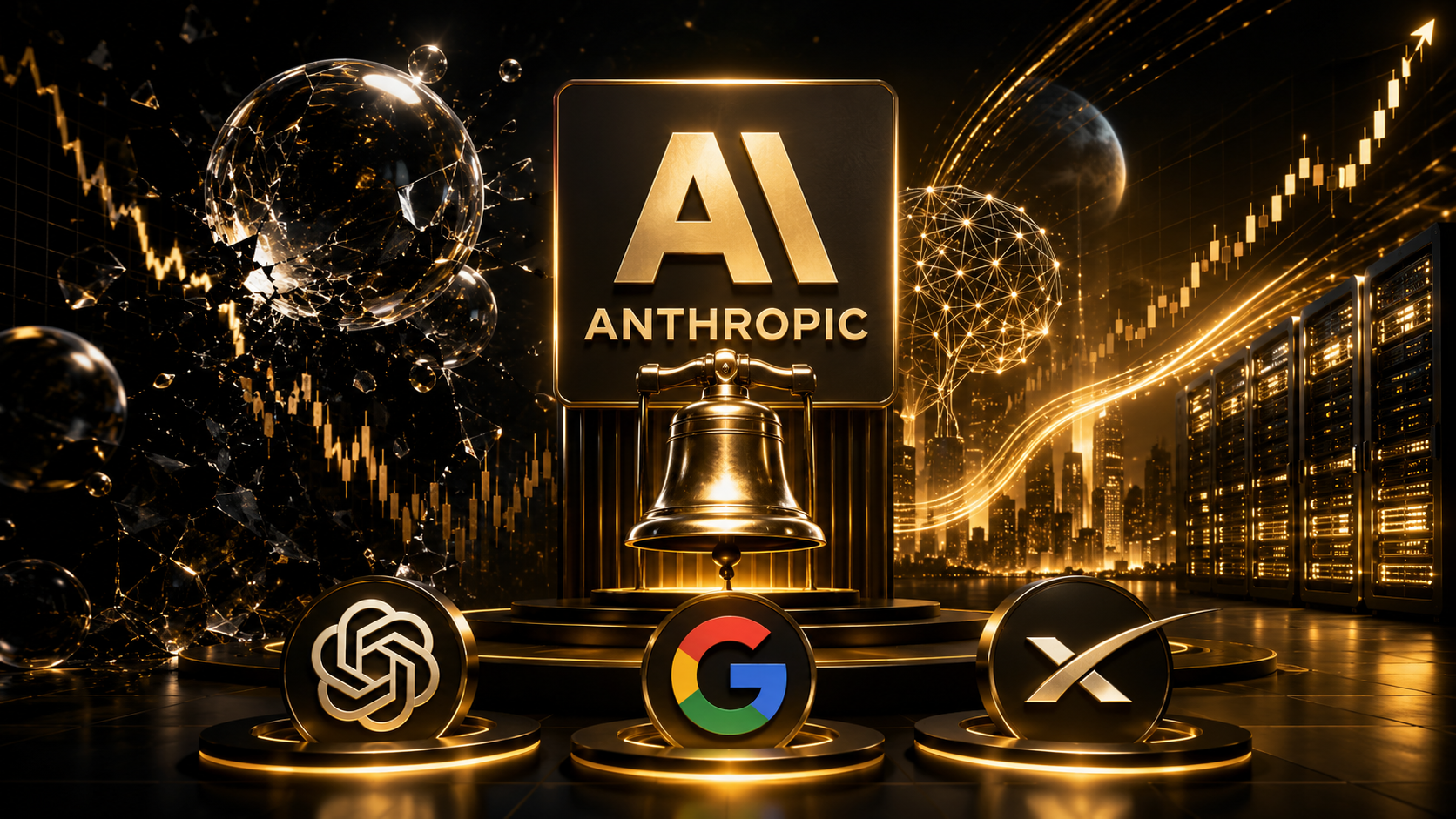
Anthropic’s decision to file for an initial public offering has intensified speculation that a new wave of artificial intelligence companies is preparing to enter public markets. The company behind the Claude chatbot revealed that it had submitted paperwork to the US Securities and Exchange Commission for an expected Wall Street debut later this year. The filing marks another major milestone in the company’s rise from a startup founded in 2021 by former OpenAI leaders to a business valued at nearly $1 trillion.
The move is widely expected to be followed by rival OpenAI as investor demand for artificial intelligence exposure continues to strengthen. At the same time, Alphabet announced plans to raise $80 billion in equity to support AI infrastructure investments, marking its first stock offering in more than 20 years and one of the largest equity fundraising efforts ever undertaken. With SpaceX also recently announcing plans to list on the Nasdaq, a growing number of technology giants are turning to public markets as competition within the AI sector accelerates.
While the announcements have generated significant excitement, analysts are increasingly questioning whether surging valuations and record fundraising plans are beginning to resemble the conditions that preceded the collapse of the dot com boom.
Anthropic Moves Ahead in the Race to Public Markets
Anthropic’s IPO filing represents one of the most significant developments in the artificial intelligence sector this year. Founded in 2021 by former OpenAI executives, the company has rapidly established itself as one of the leading players in the AI industry. Its Claude model has gained increasing popularity, helping Anthropic emerge as a serious competitor to OpenAI despite ChatGPT’s early success in bringing generative AI into the mainstream.
The company’s valuation of nearly $1 trillion highlights the extraordinary level of investor enthusiasm surrounding artificial intelligence. The filing also places Anthropic at the front of what many expect will become a broader wave of AI related public offerings. OpenAI is widely anticipated to pursue a similar path as companies seek to capitalize on strong investor demand for exposure to the sector.
The growing interest in public listings reflects the scale of investment flowing into artificial intelligence and the increasing importance investors place on companies developing advanced AI technologies.
Alphabet’s $80 Billion Raise Signals a New Reality for Big Tech
Anthropic’s IPO filing was not the only major announcement to capture market attention. Alphabet revealed plans to raise $80 billion through an equity offering to fund AI infrastructure investments. The move is particularly notable because it represents the company’s first stock offering in more than two decades.
The size of the planned fundraising effort underscores how central artificial intelligence has become to the strategies of the world’s largest technology companies. As competition intensifies, companies are committing larger amounts of capital to secure their positions within a market that is evolving at extraordinary speed.
The announcement also drew attention because of its scale. An $80 billion raise places the offering among the largest equity fundraising efforts ever announced and demonstrates the financial commitments companies are willing to make in pursuit of AI leadership.
Analysts Warn of Echoes From the Dot Com Era
Despite the enthusiasm surrounding artificial intelligence, some market observers are becoming increasingly cautious. Susannah Streeter, Chief Investment Strategist at Wealth Club, warned that the expected wave of AI listings could further fuel concerns that parts of the market are moving into bubble territory.
According to Streeter, the strong investor appetite expected for these offerings reflects how AI enthusiasm is creating massive valuations across the US technology sector. She noted that much of the growth achieved by leading AI companies has occurred while they remained private, meaning a substantial portion of the value creation may already have been captured by early investors before public shareholders gain access.
Streeter also drew comparisons with the dot com boom, arguing that there are clear echoes of the period when optimism surrounding the internet drove technology stocks to extreme valuations before confidence eventually collapsed as funding conditions tightened. Her warning highlights growing concerns that investor excitement could be pushing valuations beyond sustainable levels.
Why Today’s AI Companies May Be Different
Although Streeter pointed to similarities with the dot com era, she also emphasized that today’s leading AI companies differ from many of the highly speculative businesses that emerged during that period.
According to her assessment, companies such as Anthropic, OpenAI, and SpaceX are building ecosystems around artificial intelligence, data infrastructure, and computing power that could influence the global economy for decades. That distinction is an important part of the debate surrounding current valuations, as many analysts believe the strongest AI companies possess more substantial foundations than many internet businesses did during the height of the dot com boom.
The comparison therefore centers less on the quality of the companies themselves and more on the pace at which investor expectations and valuations are rising.
How Big Tech Is Rethinking the Way It Funds Growth
Nicholas Hyett, Lead Alternatives Analyst at Hargreaves Lansdown, said the fundraising plans announced by Anthropic and Alphabet represent a major change for large US technology companies. He noted that many of the industry’s biggest players traditionally prided themselves on operating capital light business models that generated cash rather than consuming it.
The scale of the fundraising efforts now being pursued suggests that artificial intelligence is reshaping those long established assumptions. Companies are increasingly willing to raise substantial amounts of capital as they compete for leadership in one of the fastest growing sectors of the global economy.
Anthropic’s expected IPO, Alphabet’s planned $80 billion equity raise, and SpaceX’s listing ambitions collectively illustrate how rapidly the artificial intelligence industry is evolving. They also highlight why excitement surrounding AI is now being accompanied by a more difficult question. Whether the sector is entering a transformative new era of growth or repeating some of the valuation excesses that defined the dot com boom remains one of the most closely watched debates on Wall Street today.