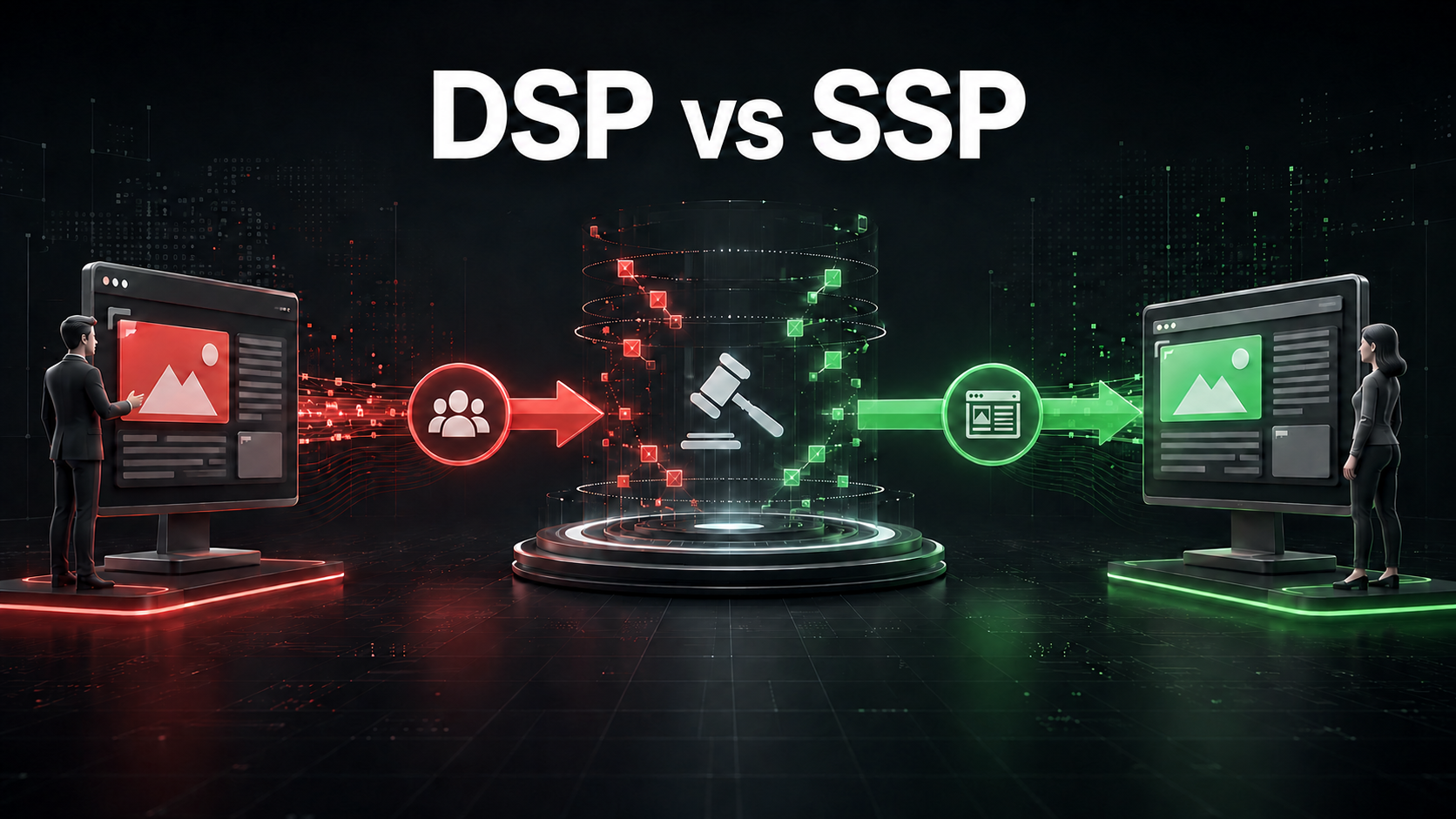
DSP vs SSP is the difference between technology that helps advertisers buy digital media and technology that helps publishers sell it. That distinction explains why The Trade Desk and PubMatic can participate in the same advertising ecosystem yet produce very different revenue, margins, and risk profiles.
The Trade Desk and PubMatic’s Q2 earnings divergence exposed a basic problem for ad-tech investors: comparing the two companies without first understanding DSP vs. SSP economics can lead to the wrong conclusion.
The Trade Desk reported Q2 2026 revenue of $715.1 million, about 9.1 times PubMatic’s $78.6 million. That scale gap does not mean a demand-side platform earns 9.1 times as much from an identical transaction. The companies sit at different points in the programmatic supply chain, have different contracts and sell different combinations of technology, data and services.
The shortest useful answer is this: The Trade Desk primarily represents advertising demand, while PubMatic historically has represented publisher supply. The Trade Desk helps agencies and advertisers decide which impressions to buy. PubMatic helps publishers make their impressions available, attract bids, and maximize monetization.
They are connected businesses, not interchangeable ones.
DSP vs SSP: the 10-second answer
| Platform | Economically serves | Core decision | Primary public-company example |
|---|---|---|---|
| Demand-side platform, or DSP | Advertisers and agencies | Whether, where, and how much to bid for an ad opportunity | The Trade Desk |
| Sell-side platform, or SSP | Publishers and app or streaming-media owners | How to package inventory, establish auction rules or floors, and sell an ad opportunity | PubMatic |
The names describe the side of the market each platform was built to serve. “Demand” is the advertising budget seeking an audience. “Supply” is the available inventory: a video break, mobile app placement, website display slot, or another opportunity to show an ad.
This is a simplified map of a typical real-time transaction:
- A consumer opens a webpage, app, or streaming program with an available ad slot.
- A publisher’s technology makes that opportunity available, often through an SSP, with authorized data and auction rules.
- DSPs evaluate the bid request against advertiser goals, budgets, audience signals, frequency limits, and expected value.
- Eligible buyers submit bids; the auction determines the winner based on the relevant rules.
- The winning creative is normally returned for delivery, the buyer is billed, and the publisher receives proceeds after relevant fees and adjustments.
Real transactions can also involve ad servers, exchanges, identity tools, data providers, and curation layers. The IAB Tech Lab’s programmatic-deals standard describes deals passing from platforms typically operated by SSPs to those typically operated by DSPs. The key point for investors is not the number of intermediaries. It is which customer the platform serves and what the company recognizes as revenue.
How The Trade Desk Makes Money
The Trade Desk describes its product as a self-service, cloud-based ad-buying platform. Its clients include advertising agencies, advertisers, and service providers working for them.
According to The Trade Desk’s 2025 Form 10-K, the company generates revenue primarily from a platform fee generally based on a percentage of clients’ total platform spend, plus value-added services and data used to support campaigns.
That wording contains three details investors should not overlook.
First, The Trade Desk is not reporting the entire media budget as revenue. The company generally reports revenue on a net basis after subtracting amounts paid to suppliers for advertising inventory and supplier-provided components of data and value-added services. Its receivables and payables can therefore look large relative to reported revenue because the company may collect and remit amounts that never become its revenue.
Second, the company’s monetization is not a single, permanently fixed fee. Revenue can change with platform pricing, volume discounts, client and channel mix, and the use of data or other value-added features.
Third, higher advertiser spend is only one growth lever. The Trade Desk can also generate more revenue if customers adopt more revenue-producing tools or if the mix of services becomes more favorable.
The 2025 numbers illustrate the distinction. Gross spend on the platform increased 11% to $13.39 billion, while revenue rose 18% to $2.90 billion. ABBO News calculates a revenue-to-gross-spend ratio of approximately 21.6%, up from 20.3% in 2024.
That ratio is not a disclosed take rate and should not be modeled as one. The Trade Desk defines gross spend to include inventory, value-added services, data, and the platform fee itself. Management also said 2025 revenue benefited from increased use of and higher pricing for value-added services and data, as well as higher platform fees. The ratio is useful as a directional monetization indicator, not as the percentage of every advertiser dollar that The Trade Desk keeps.
The Trade Desk Metrics That Matter Most
For TTD investors, the most informative operating questions are:
- Is gross spend growing, showing that more client budget is moving through the platform?
- Is revenue growing faster or slower than gross spend, and is the change explained by product mix, pricing, or discounts?
- Is customer retention remaining above 95%, and are existing clients increasing spend?
- Are platform-operations costs growing more slowly than revenue, creating operating leverage?
- Are major growth products and channels—particularly Kokai’s AI-assisted buying tools, connected TV and retail data—producing measurable spending and revenue growth?
The Trade Desk emphasizes its focus on buyers and says it does not sell owned advertising inventory. Its OpenPath offering creates a more direct connection to publishers, but the stated purpose is still to improve buyers’ access to quality inventory. A shorter supply path does not by itself turn the company into a traditional SSP.
How PubMatic Makes Money
PubMatic’s core economics begin with publishers rather than advertisers.
The company helps publishers sell digital ad impressions in real time and provides tools for inventory management and monetization across formats and devices. According to PubMatic’s 2025 Form 10-K, it typically charges publishers a fee equal to a percentage of the value of impressions monetized through its platform.
PubMatic recognizes revenue when a bid is won and a buyer purchases inventory on the platform. It invoices buyers for the full purchase price, then reports revenue net of amounts paid to publishers and rebates associated with supply-path-optimization agreements.
The accounting logic is important. PubMatic says it does not control the advertising inventory or set the auction-determined price, so it treats itself as an agent rather than the principal in the inventory sale. Its reported revenue is therefore the platform’s net economics, not the total amount advertisers spent on publisher inventory.
PubMatic did not disclose a directly comparable gross-spend KPI in its reviewed 2025 Form 10-K or Q2 2026 release. Investors cannot reliably derive a companywide fee rate by dividing PubMatic revenue by The Trade Desk spend, industry ad spend, or another platform’s billings. Those denominators do not describe the same transaction pool.
PubMatic’s infrastructure model also affects profitability. The company owns the servers and network components used by its platform but hosts that equipment in third-party data centers. Cost of revenue includes co-location, hardware depreciation, capitalized-software amortization, and related personnel costs. That makes transaction efficiency financially significant: processing more valuable activity without a proportional increase in infrastructure cost can expand gross margin.
The PubMatic Metrics That Matter Most
For PUBM investors, the better questions are:
- Are monetized impressions and revenue growing together, or is volume shifting toward lower-value formats or geographies?
- Is cost per million impressions falling, and is that efficiency improving gross margin and cash flow?
- Are connected TV, mobile app, commerce media and other newer streams diversifying the revenue base?
- Is demand broadening beyond a few large DSP buyers?
- Are buyer-facing products producing incremental revenue rather than merely moving existing transactions between PubMatic tools?
Buyer concentration deserves particular attention. PubMatic’s 10-K says The Trade Desk and Google’s DV360 account for a significant portion of the ad impressions purchased on its platform. A major DSP can reduce its activity or change its pricing strategies, bidding algorithms, or go-to-market approach without guaranteeing a minimum level of spend. PubMatic can therefore execute well for publishers and still feel the effect of a major buyer’s platform decision.
Why PubMatic Now Looks Like More Than a Traditional SSP
The boundary between DSP and SSP is becoming less rigid.
PubMatic’s Activate platform lets buyers execute direct-to-supply deals across publisher inventory. The company has also launched AgenticOS for automated campaign planning, transaction, and optimization. Those products give advertisers and agencies more direct buying functionality than a conventional SSP historically offered.
That expansion matters because it could add revenue streams and reduce the number of intermediaries between buyers and publishers. It does not yet justify analyzing PubMatic as though its economics were identical to The Trade Desk. PubMatic’s latest annual filing still describes publisher impression monetization and publisher fees as its core revenue model. PubMatic did not disclose AgenticOS as a separate revenue line in its reviewed 2025 Form 10-K or Q2 2026 release.
Investors should treat the buyer-side push as an emerging growth vector whose financial contribution must be demonstrated—not as proof that the legacy business has already been replaced.
The Comparison Investors Should Actually Make
| Question | The Trade Desk | PubMatic |
| Where does it sit? | Primarily buy side | Primarily sell side, with expanding buyer tools |
| What does it optimize? | Advertiser outcomes and media buying | Publisher monetization and supply efficiency |
| How does it mainly earn? | Platform fee tied generally to client spend, plus data and value-added services | Fee typically tied to the value of publisher impressions monetized |
| How is revenue presented? | Generally net of supplier components | Net of publisher payments and applicable buyer rebates |
| Does reported revenue equal media spend? | No | No |
| Most useful scale indicator | Gross spend, alongside revenue mix | Monetized activity and revenue, alongside impression quality and mix |
| Key structural risk | Advertiser or agency spending, pricing and platform-cost growth | Buyer concentration, inventory monetization and infrastructure economics
|
This framework prevents four common analytical errors.
1. Do not compare reported revenue as if it were total ad spend
Both companies use net presentation for core transactions. The Trade Desk’s $715.1 million of Q2 revenue and PubMatic’s $78.6 million describe the net revenue each company recognized under its own contracts—not the total advertising dollars that crossed the ecosystem.
2. Do not treat percentage growth as a direct market-share transfer
PubMatic can grow faster because its publishers monetize more valuable inventory, because more DSP demand reaches its platform, or because newer products expand. The Trade Desk can slow because large advertisers reduce budgets, client execution weakens, or monetization mix changes. One company’s growth rate does not establish that it took the other’s customers.
3. Do not confuse activity with monetization
More bid requests, impressions, or AI-powered deals can demonstrate adoption. They become economically meaningful only when they improve revenue, margin, or cash generation. Low-value volume can raise infrastructure demands without producing proportional sales.
4. Do not force a fixed $100 advertising-dollar waterfall
Neither company’s reviewed 2025 Form 10-K discloses one universal fee applicable to every transaction. Contract terms, inventory, data, services, rebates, channels and supply paths vary. Any diagram claiming that a fixed number of cents from every $100 always goes to The Trade Desk or PubMatic would present an estimate as a fact.
For the latest results-based view, ABBO News also compared The Trade Desk and PubMatic on revenue, margins and key risks.
What DSP vs SSP means for TTD and PUBM stock
The Trade Desk is primarily a scaled bet on advertiser demand, data-driven decisioning, and the ability to monetize a growing share of client spend while preserving operating leverage. PubMatic is primarily a bet on independent publisher monetization, infrastructure efficiency, and its ability to attract diverse buyer demand while expanding into higher-value products.
The same advertising transaction can benefit both companies. A larger advertiser budget can produce more bidding activity for a DSP and more monetization opportunities for an SSP. The reverse is also true: weaker ad demand can travel through both sides of the chain.
Their Q2 results changed the near-term execution debate, but they did not erase the structural distinction. By reported revenue, The Trade Desk remains the much larger buyer-focused platform. PubMatic remains smaller by that measure and primarily supply-focused, although its buyer tools could widen its addressable market.
For retail investors, the practical rule is simple: evaluate The Trade Desk through spend, monetization mix, retention, and platform costs; evaluate PubMatic through monetized inventory, demand concentration, infrastructure efficiency, and revenue diversification. Only then do revenue growth and margin comparisons start to make sense.
DSP vs SSP FAQs
Is The Trade Desk a DSP or an SSP?
The Trade Desk is primarily a demand-side platform. It helps advertisers and agencies plan, buy, measure, and optimize digital advertising. OpenPath gives its clients a more direct route to publisher inventory, but the company’s core economic alignment remains with buyers.
Is PubMatic a DSP or an SSP?
PubMatic is primarily a sell-side platform. Its core model helps publishers monetize advertising inventory, although products such as Activate and AgenticOS have expanded its buyer-facing capabilities.
Do DSP and SSP revenue equal total advertising spend?
No. The Trade Desk and PubMatic both generally report their core transaction revenue on a net basis. Their reported revenue reflects the economics each company recognizes under its own contracts, not all media dollars moving through the advertising supply chain.
This article is for informational purposes only and does not constitute investment advice.